
Over a wall
Answers: who has agreed to take it over, and what's still open?
In 2012 the City of Stockholm started a project to replace the ageing systems its schools ran on, some of them with contracts about to run out.[1] Skolplattformen, the school platform, was to be one system for every kind of school, from preschool to adult education, and for about 400,000 users, counting staff, pupils and guardians.[1] The project cost 675 million kronor, within what the city council had approved.[1]
The project plan left several things out of the project, among them running the systems, which went to the city's operations supplier, and setting up the administration that would run the platform afterwards.[1] The idea was that about half the project's people would go on to work in that administration, to make the move easier.[2]
The handover went in steps from 2017. At each step the project set up training, workshops and shadowing with defined counterparts in the administration.[2] Its milestones for the handover read "Results handed over to the administration" and "Live functionality handed over to the administration".[1] The project had been due to end by 31 December 2018. Go-lives were moved back to fix problems, and it ended on Sunday 31 March 2019.[1]
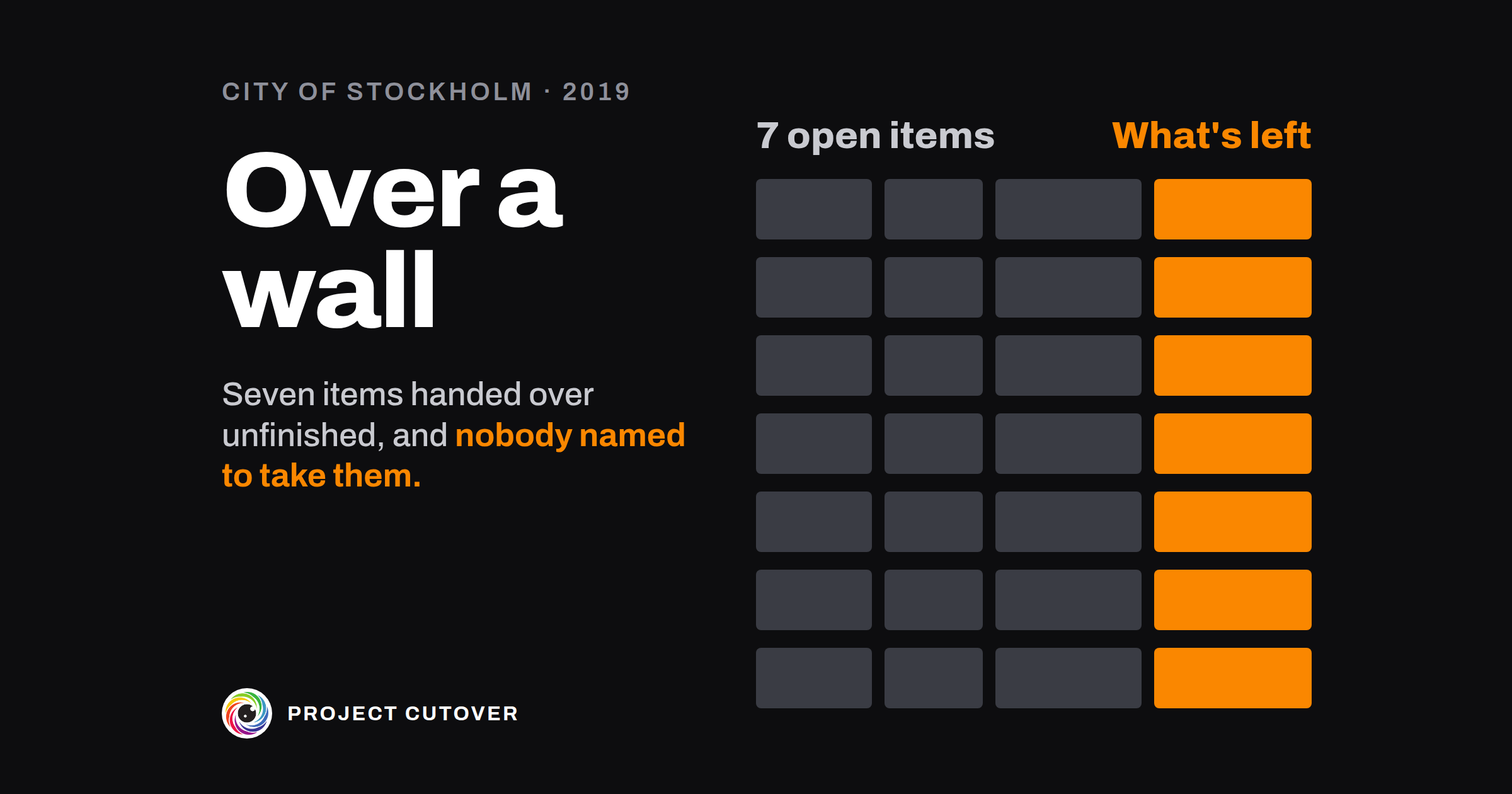
At the handover the project gave the administration a list of seven items it had been required to deliver and hadn't finished, partly because of things outside the project, mainly suppliers who had delivered late.[1] The list gave each item its status, the work done and what was left. Four were still waiting on a supplier, a decision or a switch-over to another of the city's systems. On one, a supplier was working to a plan the city had approved, and two were marked "Handed over to the administration". The project passed about 6.6 million kronor to the administration to finish them.[1]
In June 2020 Ramboll, a consultancy, wrote an evaluation for the city drawn from interviews with 44 people, some of them on the receiving side.[2] Several said the project had started planning the handover too late, and that building an administration of the size the platform needed had taken longer than planned. So, the evaluation says, "at the time of the handover there was no prepared receiver". Several in the administration described the handover like this: "It was as if the project threw Skolplattformen over a wall and hoped someone would take it."[2] Many who were to run the platform and had worked on the project had left by then. Ramboll wrote that it was still hard for the administration to understand what was to be delivered and handed over. Some documents were missing, and others were felt to be too extensive, so they weren't followed.[2]
The city's own final report found that the project had no handover plan of the kind set out in the project method it worked to.[1] Later in 2020 the City Executive Office's investigation found the administration still working through a list of what was left.[3]
The training and shadowing could have worked, staff in the administration told Ramboll, if the handover had started earlier.[2] In November 2020 the councillor who put the three reports before the city's executive board wrote that the large problems the platform had when it was brought in during 2019 had been solved by spring 2020, in time for the upper secondary schools to move to remote teaching.[4] The final report's lesson for future projects was to tie the receiving administration to the project earlier, in roles where it makes decisions, and to staff it with the city's own employees.[1]
The list handed over as the project ended had no column for who in the administration had agreed to take each item.
What Handover is
Handover is the end of a project: the people who'll run the system take it over from the people who built it, and the project closes. The field calls it transition to operations, or handover to business as usual. GovS 002, the UK government's standard for project delivery, asks for a plan for the move that covers formal acceptance, keeping the business running and the transfer of ownership, which "can be incremental or in full".[5] At close it asks for the requirements not met to be written down with how they'll be dealt with, and for responsibility for the open risks, issues, actions and benefit tracking to be "handed over to, and accepted by, the appropriate business authority".[5]
In a company of 40 handover might be a month in which the support lead's team answers the tickets without the engineers and a finance lead runs month-end on the new system. Who takes the system over, and what the project leaves them, is written down in Handover and ownership.
Who runs it
The project manager runs the handover. In GovS 002 the project manager answers to the senior responsible owner,[5] the role most companies call the sponsor, and the project manager and team oversee the first period of use, to deal with the actions, risks and issues still open.[5] Whoever will own the system day to day accepts what's handed over.
In a company of 40 that's usually one team lead in finance, support or operations, named before go-live. Most often that lead also decides the handover is accepted, since they'll be the one running the system.
What it decides
Two gates on the project's gate map fall in this stage, Handover accepted and Close, and the rollout's last waves can run on past Handover accepted. At Handover accepted one person, usually from the side taking over, decides whether the handover is accepted, and everyone taking it over signs for their part, against criteria they helped write. At Close the sponsor ends the project, and the part called Project close sets what was delivered against what was promised.
Each thing still open at handover goes to one named person, with a date or the thing its date waits on. Money to finish it, or to run the system next year, is decided above the project, by whoever holds that budget.
Its parts
- Handover and ownership The team that will run the system, named before go-live, and what the project leaves them. Answers: who owns it once the project's gone?
- Project close What was delivered against what was promised, and who owns what's still open. Answers: did we deliver what we said we would?
New pieces go out on Substack.
Subscribe on SubstackSources
- City of Stockholm. Skolplattform Stockholm: Slutrapport, version 1.0, adopted by the steering group 13 May 2020. In Swedish; quotations translated. Pages 3, 4, 7 to 10, 14, 15, 18 and 20. https://meetingspublic.stockholm.se/welcome-sv/namnder-styrelser/kommunstyrelsen/mote-2020-11-25/agenda/bilaga-slutrapport-skolplattformen-10pdf-34828
- Ramboll. Utvärdering: Skolplattformens framväxt, utformning och funktionalitet, for the City of Stockholm, June 2020. In Swedish; quotations translated. Pages 7, 9, 30 and 31. https://meetingspublic.stockholm.se/welcome-sv/namnder-styrelser/kommunstyrelsen/mote-2020-11-25/agenda/rambolls-utvardering-av-projekt-skolplattformen-juni-2020pdf-64354
- City of Stockholm, City Executive Office. Utredning och lärdomar av projektet Skolplattform Stockholm, 2020. Page 22. https://meetingspublic.stockholm.se/welcome-sv/namnder-styrelser/kommunstyrelsen/mote-2020-11-25/agenda/utredning-och-lardomar-skolplattform-stockholmpdf-87117
- City of Stockholm. PM Rotel IV, Utredning och lärdomar av projektet Skolplattform Stockholm, Dnr KS 2020/1022, 18 November 2020. Pages 1 and 2. https://meetingspublic.stockholm.se/welcome-sv/namnder-styrelser/kommunstyrelsen/mote-2020-11-25/agenda/r4-pm-utredningar-och-lardomar-av-projektet-skolplattform-stockholmpdf
- Cabinet Office. Government Functional Standard GovS 002: Project delivery, version 2.1, 1 September 2025. Clauses 4.4.9, 6.4.8, 8.8 and 8.9. https://projectdelivery.gov.uk/library-products/government-functional-standard-govs-002-project-delivery/