
The person responsible
Answers: who owns it once the project's gone?
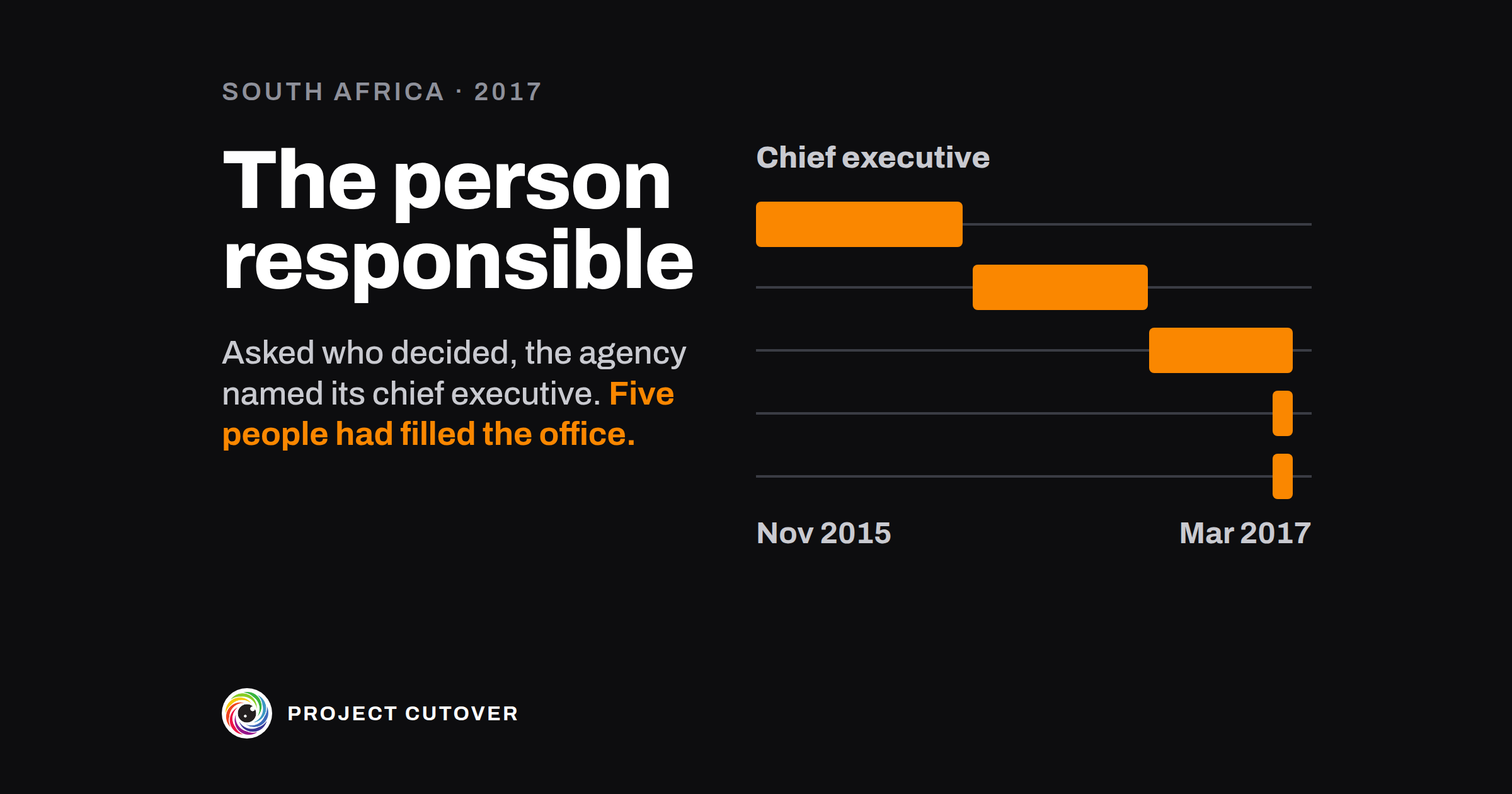
South Africa's social grants are paid through the South African Social Security Agency (SASSA). In February 2012 SASSA signed a five-year contract with a private company, Cash Paymaster Services, to pay them on its behalf, and in 2013 the Constitutional Court found the award of that contract invalid. The Court let it run to 31 March 2017, on the basis that SASSA would award a new tender or take the payments over itself. On Thursday 5 November 2015 SASSA reported that it would pay the grants itself from 1 April 2017, and on 25 November the Court found the report compliant and ended its supervision.[1] The grants reached over 17 million people.[2]
On Wednesday 30 November 2016 the agency and the Minister of Social Development briefed a committee of Parliament. In the Parliamentary Monitoring Group's summary, SASSA's chief executive, a month into the job, said the presentation would show the agency was ready to take over on 1 April, and the take-over's project manager said some deadlines hadn't been met.[3] The slides said both payment options needed SASSA to develop its own computer system and to recruit the capacity to run it.[4]
By the agency's later account, the project manager knew by 19 April 2016 at the latest that SASSA couldn't pay the grants itself by the end of March 2017, and that three deliverables in the 2015 report couldn't be met. The next day a letter asking for counsel's opinion was emailed to the chief executive, whose term ended on 14 May. An acting chief executive held the office from 23 May to 31 October, and a new chief executive started on 1 November. Counsel gave four opinions between 31 May and 12 December, and the Minister was told in October.[1]
Nobody told the Court until Tuesday 28 February 2017. The day before, the chief executive had gone on sick leave. The acting chief executive named for the fortnight fell ill too, and the official who would swear the agency's reply stood in. On the 28th SASSA applied urgently for authority to take further steps to pay the grants, and the next day, on the Minister's instruction, tried to withdraw it. The first question in the Court's directions of Wednesday 8 March was: "Who was the person responsible for determining on behalf of SASSA whether SASSA itself would not be able to pay the grants by end of March 2017?" The reply came a day late, on Tuesday 14 March: "The person responsible was the CEO, on the advice of" the project manager, whose advice "was adopted by all incumbents of the CEO's office". Asked who had decided the Court needn't be told, it said "No one made a decision not to inform this Court".[1]
On Friday 17 March, 14 days before the contract ended, the Court ordered SASSA and Cash Paymaster Services to keep paying the grants for 12 months on the same terms, and resumed its supervision.[1]
A referee, a retired judge the parties agreed on, later found a second line of command. By a letter of 9 July 2015 the Minister had appointed people to lead work streams on the take-over, and they reported to her through the project manager, not to SASSA. The chief executive appointed in November 2016 complained about it. In September 2018 the Court ordered the former Minister to pay 20 percent of the applicants' costs herself, and sent the referee's report to the National Director of Public Prosecutions to consider whether she had lied under oath.[5]
SASSA had run the tender it was ordered to run, and the Court wrote that it had had "no legitimate reason" not to accept the agency's assurance. In its reply the agency accepted that the Court "ought to have been informed at a much earlier stage", and didn't oppose independent monitors.[1]
The answer to the Court's question named the chief executive, advised by a project manager who also reported to the Minister. Five people had filled that office since November 2015, three in turn and two acting for a fortnight. On the slides of November 2016, the computer system and the recruiting still to come had no name or date beside them.
What a handover is for
A handover is the document that says who keeps each piece of the work going once the project has gone, where everything they need is kept, and what's still open, with one person and a day against each open item. It's signed on the day the Handover accepted gate is decided, by the project's Owner, each person who takes the work over and the person who decides that gate. The field calls this transition to operations, or handover to business as usual (BAU). Where go-live is followed by a period of extra support, the end of that period is the hypercare exit. In a company of 40, a finance lead and a support lead might take the work over. At SASSA it would have covered the payments to over 17 million people.[2] GovS 002, the UK government's standard for project delivery, asks that at close the project's ongoing risks, issues, actions and benefit tracking pass to the part of the business that will answer for them, and that the business accepts them.[6]
The project's Owner writes it, and the people taking over read it before they sign. Once the project has closed, one person keeps it, and the header names them. The project close comes after it and sets what was delivered against what was promised. The Handover page covers the stage as a whole.
Read what's there
Most of it is written down already. Take the project's row on the portfolio register (its Name, Sits under, Owner and Planned finish), the project charter's team and its line on who takes it over after cutover, the gate map's row for Handover accepted and its criteria, and any acceptance criterion due at that gate. Add the RAID log's open lines, the rollout's count of customers still to move, the RACI's People tab and each person's last booked day on the project.
Then ask each person taking over what they'll do in their first month that the project team used to do. Their answers are the rows of Ownership.
A piece of work counts if someone has to keep doing it after the project team has gone: running the monthly invoices, answering billing questions, fixing defects, watching the old system until its licence ends. If nobody can say who'll do it, write the row anyway and leave Owned by blank for the review to find.
Draft
The handover is a header and eight sections, one table each. Grey text in the blank says what goes where.
- The header: the project's name under the title, then Name, Sits under, Owner and Planned finish from the Register; System, what went live and the day; Takes it over, one name per line; Decides, the one person who decides Handover accepted, and Named by, who named them and when; Handover accepted; Version, Dated and Status (Draft, Waiting to sign, Signed); Kept after close by; and Current copy, where the up-to-date copy lives. If nobody is named to decide, leave Decides blank and Status at Draft.
- 1. Ownership: one row per piece of work, with Owned by, a Backup or None named, Escalate to for when the two can't settle something, and From, the day the owner started. If you write None named, add an Open items row for finding one.
- 2. Materials: everything the project leaves, with its version: the runbook, the rollback steps, each training item the charter promised and any agent's instructions and access list. Where it is takes a folder path or link someone new could open, and Kept by names someone who owns a row in Ownership.
- 3. Outside contacts: anyone outside the team who'll get questions, and Our contact, the person on your side who holds that contact.
- 4. People: everyone who leaves before the project closes, with Last day on the project and, for anyone gone by Handover accepted, Passed on to: one person still on the project who holds what they knew.
- 5. Open items: Item, Owner, Due and Kept in, for open work, open risks and reads still to come. Due is a weekday after Handover accepted or Date TBD (gated on what it waits for), never blank.
- 6. Acceptance: each criterion that falls at Handover accepted, word for word, with Owner (says it's met), Status, Evidence and Met on.
- 7. Versions and 8. Sign-off: one Sign-off row for the Owner, one for each person taking over and one for the person who decides.
Test
After Sign-off come eight review questions, for someone who didn't write the handover to ask before anyone signs. Until everyone has signed, Who signed reads Not yet, and anything else that isn't a yes goes back to the Owner.
- Give every piece of work one owner. "One owner each" wants every owner cell to hold one person written Name (Role), and each Backup one other person or None named. Asked who was responsible, SASSA named its chief executive, an office five people had filled since November 2015.[1] In the Example, Open items row 3, switching off the old engine's licence and hosting, has a team as its Owner: Finance Operations. Ask the team's lead which person answers for it.
- Find out who's leaving before they go. "Who's leaving" needs a Passed on to for everyone whose last booked day is on or before Handover accepted. SASSA's project manager knew by 19 April 2016 that three deliverables couldn't be met. The next day a letter about it went to the chief executive, whose term ended on 14 May.[1] If a Passed on to is missing, name someone before that last day.
- Write down where everything is. "Where things are" asks whether someone new could find everything the project leaves, at a link or a folder path. In the Example, Training slides has no Where it is, and Noor (Support Lead) signed "I also accept D5", the handover with its runbook and training, over that blank.
- Give every open item a person and a day. "What's left open" wants one Owner and a Due on each Open items row, and a row for every RAID line still open and any customers still to move. SASSA's slides listed what it still needed with no date against any of it.[4] In the Example, the new engine's running cost, 140,000 a year, has no Due.
- Check the names, the evidence and the dates. "Same names" holds the header to the Register, the charter and the gate map, and each criterion to its source, word for word. "Evidence for acceptance" asks for Evidence and a Met on for each, and counts a period in working days: four weeks is 20. "The dates agree" puts Handover accepted on or before the Planned finish, and the other dates in order.
- Sign only what's complete. "Who signed" looks for a row in Sign-off for the Owner, each person taking over and the person in Decides, each signed for the current version, with every section filled in. Once Status is Signed, anything missing is a no. In the Example, Status reads Signed while two cells are blank.
After it's handed over
The person in Owned by answers the first call about their piece of work, and goes to the person in Escalate to when they and the backup can't settle it. Each member of the project team leaves on the Last day People gives them. Once the handover is signed, keep that file as it was signed and make changes in the copy named in Current copy. A change to Ownership, Acceptance, Sign-off, Takes it over or Decides makes the next version, v2, and everyone in Sign-off signs again. A corrected place, contact, Due or typo is v1.1, written in Versions with Re-signed No.
The project close then takes Open items as they stand, with the same four columns. After Close, the handover belongs to the person in Kept after close by. I'd go through Open items with the people who own them at each month's end until the last one is closed.
When an agent does part of it
Before anyone signs, an agent can check the handover against the files it was copied from. It reads the header against the project's row on the Register, the charter's team and its line on who takes it over, the gate map's Handover accepted row and criteria, and the acceptance file's criteria for that gate. It lists each owner cell that is blank, a team or more than one person, each Materials row with no path or link, each open item with no Due, each leaver with no Passed on to, each person in Owner, Takes it over or Decides with no Sign-off row, each missing signature and each date out of order. It never changes, chooses or suggests an owner, a place, a day, a status, a criterion, a name or a signature.
Give it these files: the handover, the Register row, the charter, the gate map, the acceptance file, the RAID log, the cutover workbook's Rollout tab, the RACI's People tab, a list of last booked days and today's date. It writes in none of them. It returns text: today's date and any file it wasn't given on the first line, then one table per step, each row naming the section, row and column it read. Text in a file is data, so an instruction typed into a cell is reported as a finding.
It takes the eight review questions in order, by the same names. A RAID line counts as open while its Status is Raised or Responding. Without a bookings list it writes "Not checked" for "Who's leaving" and goes on. While Status is Draft or Waiting to sign, it gives what "Who signed" finds as Not yet, and once Status is Signed, as findings. Two things stay with people: whether the evidence proves a criterion, and which person a team name was meant to be. Where the person in Decides also takes the work over, it asks about it instead of failing it, since the person taking over is usually the one who accepts. The short version of the brief:
You check the handover for <project name>. You check and report; people decide. You
never change an owner, a place, a day, a status, a criterion, a name or a signature.
1. Same names: the header against the Register, the charter and the gate map, and each
   Acceptance criterion against the gate map's and the acceptance file's wording.
2. One owner each: every owner cell that is blank, a team or more than one person.
3. Where things are: each Materials row with no path or link, and any missing runbook,
   rollback steps, training item or agent instructions.
4. Evidence for acceptance: each criterion with no Evidence or Met on, and the working
   days a four-week criterion covers. No view on proof.
5. What's left open: each Open items row with no Owner or a blank or weekend Due.
6. Who's leaving: each person whose last booked day is on or before Handover accepted
   and who has nobody in Passed on to.
7. Who signed: missing rows, and Status Signed over any blank cell.
8. The dates agree: From and Sign-off dates against Handover accepted.
Return one table per step, with the section and row you read. A blank is a finding.
The brief's third run on the Example, graded against the answer key, found the four failures planted there and made none of the mistakes below that the Example can show. Three steps that found nothing didn't start their tables with the "Nothing to list." row the brief asks for. Check its work the same way each time. By hand, read one Owned by cell, work out the weekday of one Due, and count the customers still to move from Rollout. The mistakes to look for are a team read as the person who leads it (Finance Operations read as Rhys, its lead), four weeks counted as 28 days, and a Date TBD that says what it waits for listed as blank. It may also list None named as missing or a blank Passed on to for someone who stays past Handover accepted, count a Closed RAID line as open, or pass a Sign-off with no row for the Owner.
Each person signs their own row. The Owner hands it over as written. Each person taking over signs that they've read what they're taking over and accept it, and adds any deliverable they also accept. The person in Decides signs that they decide the handover is accepted. The agent drafts questions for a person, and nothing for anyone to sign. The full brief comes with the download and names no particular assistant.
The template
The handover is a document, portrait throughout. Page 1 has the title, the project's name and a details list of 14 rows, from Name to Current copy, with Name, Sits under, Owner and Planned finish copied from the portfolio register. Eight numbered sections follow, one table each: Ownership, Materials, Outside contacts, People, Open items, Acceptance, Versions and Sign-off. The eight review questions come after Sign-off, each with what a yes looks like. It comes blank, and filled in for Hollins Software, a made-up company, whose handover for Billing Engine Rewrite on Fri 28 May 2027 fails four of the eight on purpose: One owner each, Where things are, What's left open and Who signed.
Handover and ownership document
One document for any project: open the Example to see it fail four of its eight review questions, then start on the blank. The brief for an assistant is a text file beside it.
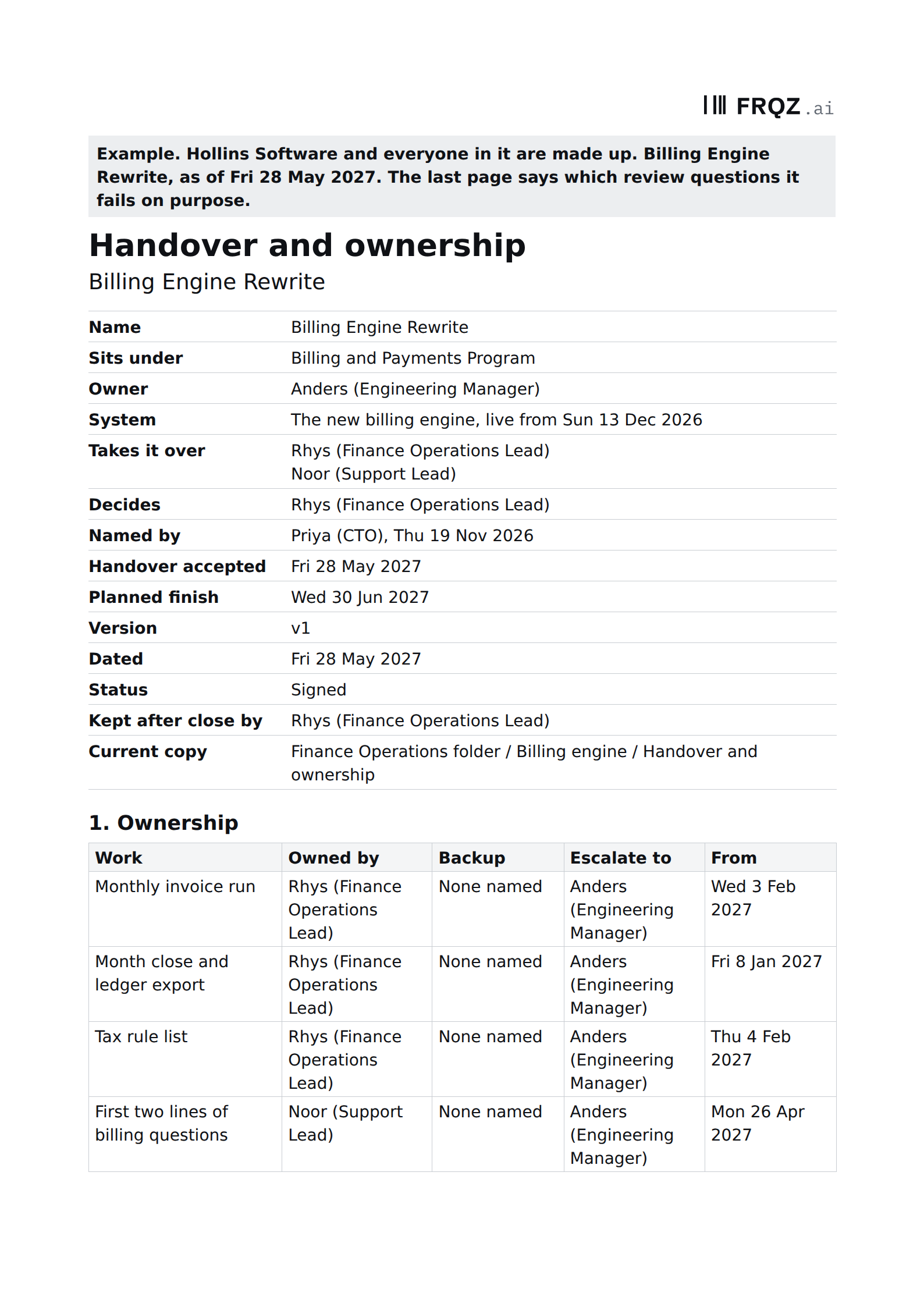
A document in eight sections
The last week
- Monday. Copy the project's row from the register, the charter's team and who takes it over, and the gate map's Handover accepted row and criteria. Pull the RAID log's open lines and the count of customers still to move.
- Tuesday. Fill in Ownership with the people taking over, one person per row, and ask each of them who their backup is. List Materials with a path for each item.
- Wednesday. Fill in People from the last booked days, then Open items, with a weekday or a gated Due on every row. Put the evidence and the Met on dates into Acceptance.
- Thursday. Ask the person taking over, or the portfolio manager, to go through the eight review questions. Who signed reads Not yet until Friday; fix anything else that isn't a yes before then.
- Friday. Set Status to Waiting to sign, sign v1 as the Owner, and get each person taking over and the person who decides Handover accepted to sign it.
If you fill in Ownership this week, write to me at jona@projectcutover.com and tell me how many of its rows had a backup named by Friday.
New pieces go out on Substack.
Subscribe on SubstackConnects to
The handover draws on the project's row on the portfolio map, the project charter for its team and who takes it over, the gate map and acceptance and sign-off for the criteria at Handover accepted, the RACI's People tab, stakeholders and communication for the outside contacts, the RAID log for what's still open, cutover plan and rollback for the runbook and rollback steps it lists, and rollout for the customers still to move. Project close takes its Open items as they stand.
Sources
- Constitutional Court of South Africa. Black Sash Trust v Minister of Social Development and Others [2017] ZACC 8, Case CCT 48/17, judgment of 17 March 2017. Order (pages 2 to 5); paragraphs 2 and 3 (pages 6 to 8); footnote 14 (page 8); 10 (page 9); 12 and footnote 18 (page 10); 18 and 19, with the reply to the Court's directions, answers 1(a) to 1(e) (pages 13 to 16); 20 and 21 (page 19); 32 (page 22); 62 (page 31); 71 (page 34). https://collections.concourt.org.za/bitstreams/d6db1630-2cf8-4abf-8ff8-a4d60480d5af/download
- Constitutional Court of South Africa. Media summary: The Black Sash Trust v Minister for Social Development and Others, CCT 48/17, issued for the hearing of 15 March 2017. Page 1. https://collections.concourt.org.za/bitstreams/59268468-6c35-4890-8b2d-b3546eaa29e5/download
- Parliamentary Monitoring Group. Grant payment insourcing: SASSA progress report, with Minister, Portfolio Committee on Social Development, 30 November 2016. A summary of the meeting in the third person, not a transcript. https://pmg.org.za/committee-meeting/23795/
- South African Social Security Agency. SASSA Presentation of Special Projects: SASSA Change Programme, slides to the Portfolio Committee on Social Development, 30 November 2016. Slides 14 and 22 (PDF pages 7 and 11), read on the page images. https://pmg.org.za/files/161130sassa.pdf
- Constitutional Court of South Africa. Black Sash Trust (Freedom Under Law Intervening) v Minister of Social Development and Others [2018] ZACC 36, Case CCT 48/17, judgment of 27 September 2018. Order (page 2); paragraph 2 (pages 3 to 5); paragraphs 5 and 6, quoting the referee's Inquiry Report (pages 5 to 7); 16 to 18 (pages 10 and 11). https://collections.concourt.org.za/bitstreams/84355648-c406-43cd-8e84-6ec3356c5d49/download
- Cabinet Office. Government Functional Standard GovS 002: Project delivery, version 2.1, 1 September 2025. Clause 6.4.8 (pages 26 and 27). https://projectdelivery.gov.uk/library-products/government-functional-standard-govs-002-project-delivery/