
The affordability line
Answers: what are we running, and who owns each one?
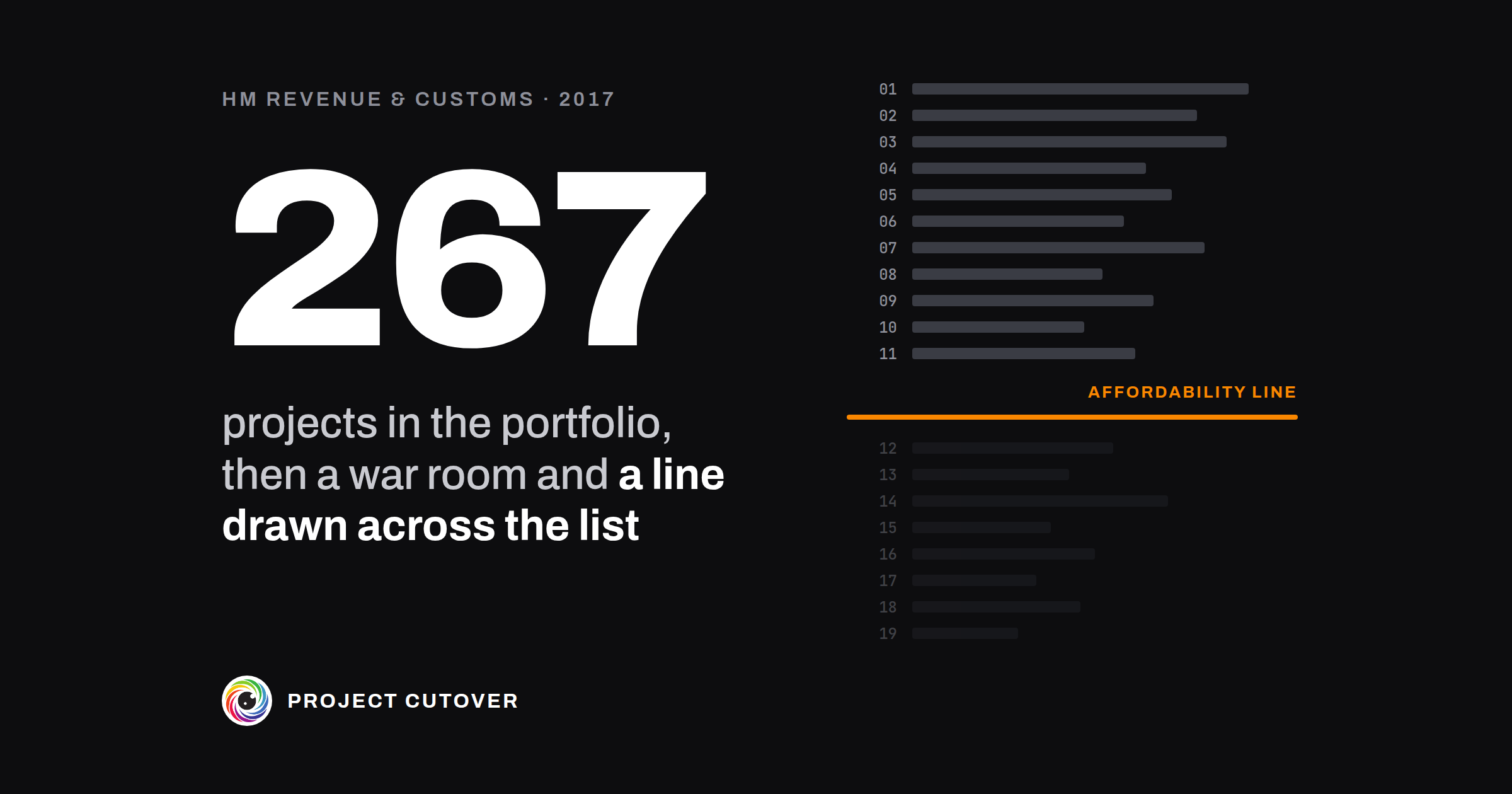
In 2015 the UK's tax authority, HM Revenue & Customs, was given £1.8 billion to change how it collects tax. In return it promised £1.9 billion of savings by 2020 and £920 million of extra tax.[1] The work ran as 15 programmes. Among them were digital tax accounts for people and for businesses, a new customs system, 13 regional centres to replace a spread of older offices, and the data and IT platforms the rest would stand on.[1]
Each programme had its own business case. Their early requests for 2017-18 came to £710 million. The transformation budget for the year was £457 million.[2]
By the autumn of 2017 HMRC had accepted that its plans weren't realistic. In the words of the National Audit Office, it "had set an unachievable timetable in which to undertake a large amount of change simultaneously", and it had more projects than it could deliver. The vote to leave the EU had added to the pressure.[1]
So HMRC set up a war room. Its people scored every project against seven weighted criteria and ranked them, then drew what they called an "affordability line" across the list. Projects above the line carried on, and those below it were stopped or sent on to wider business planning through the "Star Chambers", meetings of senior officials and the Treasury.[1]
The portfolio had started the year with 267 projects. By the end of it, 111 had finished and 31 had been stopped or paused after a first scoping review. The ranking stopped another 8 and folded 70 into other projects. Meanwhile 81 new ones had arrived, most of them for Brexit or for tax changes the government had announced since 2015. That left 128.[1]
The auditors found the method clear, and found that it released the capacity HMRC had planned. Cost had been chosen as the main reason for the ranking "because costs are easy to quantify", and the scoring favoured projects where a lot had already been spent. Projects that others depended on, such as HMRC's enterprise data work, landed low on the list, though HMRC kept funding them. Dependencies between projects weren't one of the criteria; they were "covered in discussions throughout the process". And HMRC kept a record of the key decisions from the war room "rather than full details of the discussions".[1]
HMRC already had a list. In its report on 2016-17, the National Audit Office had noted that HMRC was "managing the programmes as a single portfolio".[2] The asks could have been added up against the money on that list at any point, and the people counted the same way. Money and people are the two things every portfolio runs out of.
What a portfolio is for
A portfolio is all the work an organisation has under way that draws on the same money and the same people, kept as one list by someone who can stop things on it. The field calls that list a portfolio register or a project inventory. In a company of 40 it might be eight rows on a whiteboard; at HMRC it ran to 267.
The UK government's standard for project delivery, GovS 002, asks for two named people at the head of every portfolio: a director, who sets its direction and answers for it, and a manager, who plans and runs it as a whole and watches the spend against the budget. It also asks that a record of the work be kept up to date, with each item's type, the person responsible, its status and what it depends on.[3]
Read what's there
Before you draft anything, find out what's running. The approved list from the last planning round is a starting point, and it's usually short, because plenty of work starts without being approved.
Take every project or board in your tracker with activity in the last 30 days, and every cost code or budget line in finance that's spending this year. Add every statement of work you have with a supplier. Then ask each team lead what their team worked on last week.
Put it all in one list, then merge the duplicates, since the same work often shows up under different names. A thing counts if it draws on the same people as everything else. A "small fix" that has had two engineers on it for a quarter is a project.
Draft
The register has one row for every program and every project. Projects inside a program get their own rows too, because that's where the people and the money are.
For each row:
- One named person who owns it. If a team owns it, write the name of whoever speaks for the team. If you can't name anyone, leave it blank for the test to find.
- What it sits under. A program, or the portfolio itself. Exactly one.
- Its status, from a short list everyone uses the same way. GovS 002 suggests proposed, in progress, paused, terminated and completed.[3]
- The objective it serves, in the words of the business plan. A row that serves none of them is a question for the director.
- When it's planned to finish, and where that date stands now.
- This year's forecast spend, and for the rows directly under the portfolio, the budget they've been given.
At the top of the register go the names of the director and the manager, the money there is for the year, and the date of the next review.
Test
Each of these can fail, and you want to know before anyone relies on the list.
- Add up the money. Total this year's spend across every row and put it next to the money there is. HMRC's asks came to £710 million against £457 million.[2] If yours is over, take it to the director this week.
- Count the people. For each person, count the active rows they're named on. Dates start to slip for anyone named on more than a handful. The template counts each owner's current rows for you and sets no limit.
- Look for twins. GovS 002 asks the portfolio manager to confirm, before anything starts, that it "does not conflict with or duplicate other related work".[3] Between 1998 and 2003, four US Navy commands each began their own trial of business software, on the same commercial product, each paid for from its own budget. By the time the Government Accountability Office reported in 2005, they had spent about $1 billion, and none of the four systems could work with the others. Its summary: "In short, the efforts were failures and $1 billion was largely wasted."[4]
- Ask what the next yes would stop. Take the request most likely to be approved next and ask the director what comes off the list to make room for it.
- Find what the others need. Before anything is ranked, list the rows that other rows depend on, such as a data platform or an identity service, and take that list into the ranking. HMRC's ranking had no criterion for this, and its data work came out low.[1]
Keep it current
The portfolio manager keeps the register and the director chairs the review. Once a month, check each row's owner and status, and add up the money and the people again. The full re-rank runs on a cycle the director sets. I'd start with quarterly, and run it again whenever a large piece of work arrives that can't wait. HMRC committed to doing it every year.[1]
Keep a steering log beside the register. Every time something starts, stops or pauses, write down what was decided and who decided it. Put the reason, and the options that were on the table, in the same entry. HMRC kept a record of what the war room decided, without the discussions behind it, and the next re-rank needs the reasons.
When an agent does part of it
An agent is good at the counting. It can pull the first list from the tracker and the finance codes, match the same work across three names, re-add the money and the people every week, and flag a row with no owner or a review date that's passed.
Ranking the list and deciding what starts or stops stay with people. The criteria for the ranking are agreed before any row is scored, and every start and every stop is the director's decision, written in the steering log with a name against it. An agent can draft that entry for the director to sign.
The template
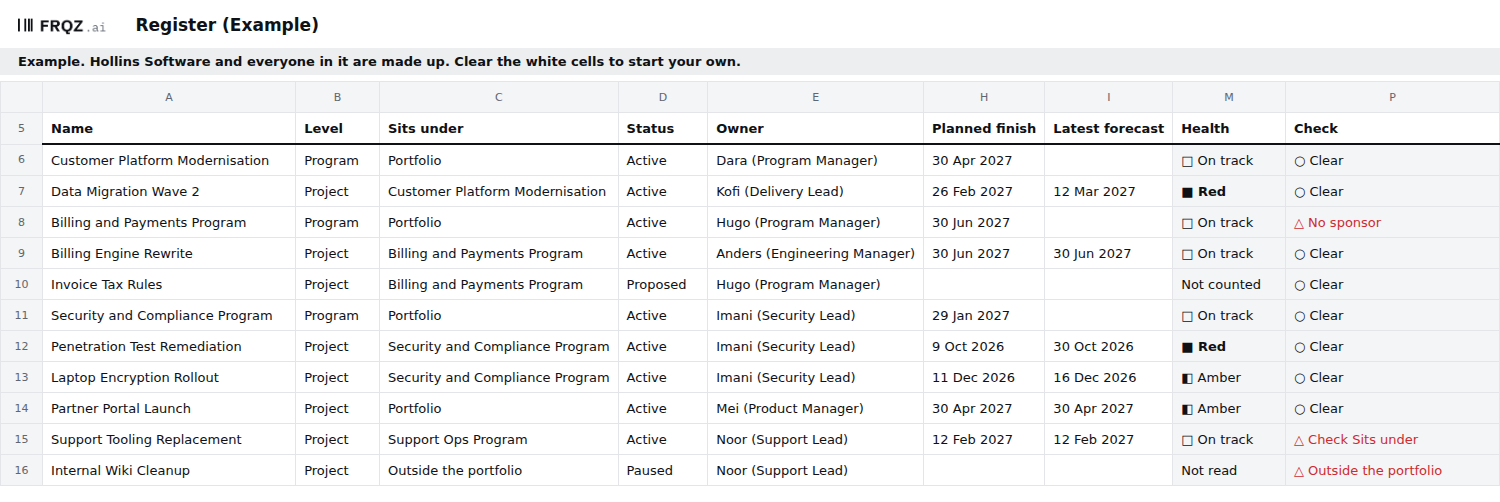
There are two versions. Each comes blank, and filled in for a made-up software company that fails some of its own checks on purpose. In the Starter, four of the seven tabs hold the register: the register itself, the steering log, a Read me, and a Portfolio tab that holds the director, the manager, the objectives and the money there is to spend. Each register row has an owner, a status, dates and money, and works out its own health. Seven checks run across them, and a row that fails one says so in words. The other three tabs each have a page of their own: the Board the steering group reads, Intake for new requests, and Capacity for who is free. The Full version adds a Funding tab for where the money came from, meetings and actions in the steering log, and a Checks tab with twelve checks in all. Its register has the same columns, so rows paste across from the Starter.
Portfolio workbook
Start with the Starter. Move to the Full when the steering group meets on a schedule and the money is split by program; the register's columns are the same in both.
Seven tabs
Nine tabs
The first week
- Monday. Pull the lists: the tracker, the finance codes, the contracts and the team leads.
- Tuesday. Merge them into the register, one row each, with a named owner on every row you can.
- Wednesday. Add up the money and count the people.
- Thursday. Take the twins and the unowned rows to the director, and ask what the next likely yes would stop.
- Friday. Set the date of the first review and write the first entry in the steering log.
If you add up the money this week, write to me at jona@projectcutover.com and tell me how far over it came out.
New pieces go out on Substack.
Subscribe on SubstackConnects to
The register draws on four other parts of Delivery: each program's charter says what the program is for, each project's status report says where it stands, intake is where an accepted request comes from, and the project close is where a project's Status and Forecast spend change once Close is decided. Each program's charter and roadmap read the register for the program and its projects, and each project's charter, acceptance and sign-off, RACI, stakeholders, handover and ownership and project close start from its row.
Sources
- National Audit Office. HM Revenue & Customs 2017-18 Accounts: Report by the Comptroller and Auditor General, July 2018, printed in HMRC's Annual Report and Accounts 2017-18. Summary paragraphs 9 to 12 (pages R6 to R7); Part Two, paragraphs 2.7 to 2.12, Figures 6 to 11 (pages R26 to R32). https://assets.publishing.service.gov.uk/government/uploads/system/uploads/attachment_data/file/724943/HMRC_Annual_Report_and_Accounts_2017-18__print_.pdf
- National Audit Office. HM Revenue & Customs 2016-17 Accounts: Report by the Comptroller and Auditor General, Summary, July 2017. Paragraphs 11 and 12. https://www.nao.org.uk/wp-content/uploads/2017/07/HM-Revenue-Customs-2016-17-Accounts-Report-by-the-Comptroller-and-Auditor-General-Summary.pdf
- Cabinet Office. Government Functional Standard GovS 002: Project delivery, version 2.1, 1 September 2025. Clauses 4.4.5, 4.4.6, 5.2 and 5.3.5. https://projectdelivery.gov.uk/library-products/government-functional-standard-govs-002-project-delivery/
- U.S. Government Accountability Office. DOD Business Systems Modernization: Navy ERP Adherence to Best Business Practices Critical to Avoid Past Failures, GAO-05-858, September 2005. Highlights page and pages 11 to 14. https://www.gao.gov/products/gao-05-858