
No longer realistic
Answers: what's waiting on what?
The Betuweroute is a 160-kilometre railway with two tracks that carries only freight, from the port of Rotterdam to the German border near Zevenaar. It opened on 16 June 2007. Building it cost the Dutch state 4,694 million euros at 2009 prices, 4 percent more than the 1996 estimate once inflation is taken out, which the Netherlands Court of Audit, the Algemene Rekenkamer, called relatively low by international standards.[1]
It was built to take 160 trains a day. By 2014 about 100 a day ran on it, which met the share of the rail freight between Rotterdam and Germany it had been forecast to win. The Court of Audit found that about 100 was the most it could carry, because the connection to the German network hadn't been built.[1] That connection is a third track on the German side, from Emmerich at the border to Oberhausen. On 26 July 2013 the state of North Rhine-Westphalia, the German federal transport ministry and Deutsche Bahn signed the agreement to pay for it, 1.5 billion euros.[2] In October 2014 the Dutch junior minister responsible for rail, the State Secretary,[1] told Parliament the line would then go from 110 trains a day in 2013 to 160 in 2022, and would lose capacity until then whenever the German works closed it.[2]
Building the track needed twelve permits,[3] one for each section of the route.[4] On 31 March 2016 the State Secretary wrote that one had been issued, for the part near Oberhausen, and the city of Oberhausen had appealed it in court. The other eleven were still going through. The letter said that so far this had given the German partners no reason to change the official plan, which ended in 2022.[3] From 17 April to 18 October that year the Dutch line was only partly open while the German side did preparatory works: one track was closed for 166 days and both for 18. The freight moved to other border crossings, and the detours ran well.[3][4]
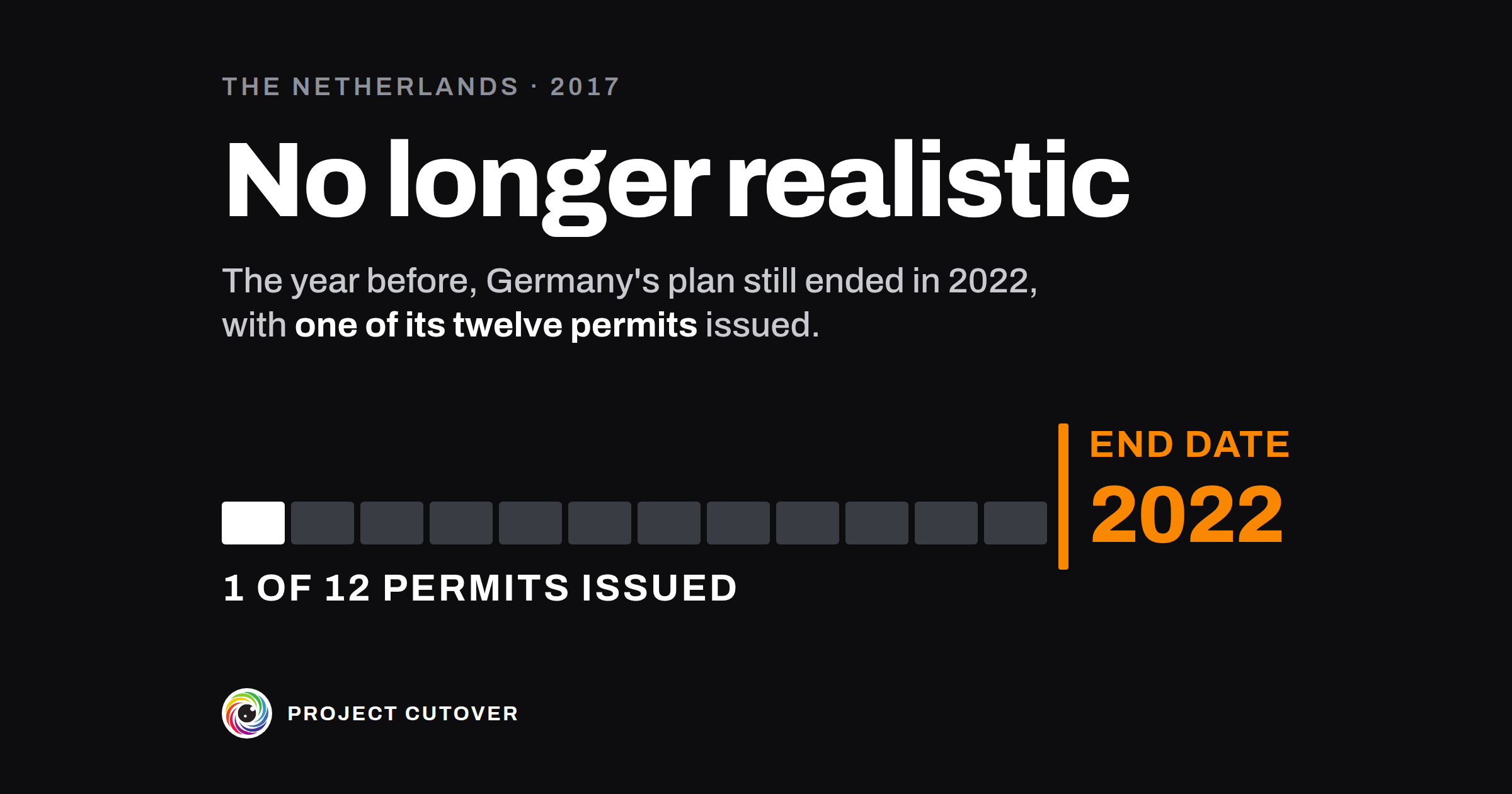
On 15 February 2017 the State Secretary wrote again. In recent contacts with the German partners it had become clear that finishing the works in 2022 was "no longer realistic". The German federal government had told the Bundestag in August 2016, in a letter from its transport ministry, that the permits for the twelve sections would be issued over the coming years, the last of them in 2019, and that it would give a reliable date for opening the track only once every permit procedure was finished. The State Secretary expected the end date to move "a few years". DB Netz, the German rail manager responsible for the building, had put off many of the works planned for 2017, and freight would still have to be detoured after 2022.[4]
In November 2017 there were still no new permits. The authority responsible for them, the Eisenbahn-Bundesamt, was wholly independent in the matter, and the German federal ministry couldn't estimate how long its procedure might still take.[5] By July 2021 five of the twelve had been granted. The German state secretary had always assured his Dutch counterpart that he was doing everything the law allowed to speed the procedures up.[6] In December 2025 the Dutch State Secretary told Parliament that the Dutch side of the works was finished, that the German side still hadn't given a planned completion date, and that, as things stood, a full connection would not be ready within the next ten years.[7]
The Dutch line came in close to its estimate and met its traffic forecast.[1] Germany signed the funding agreement in 2013,[2] and in 2021 the two rail managers worked out how to keep an average of 80 freight trains a day running through an 80-week closure of one track, from November 2024 to May 2026, where the original plans had allowed 30.[6]
The Dutch plan carried 2022 because the German plan did, and the German plan rested on twelve permits from an authority the German ministry described as wholly independent. Nobody in the plan could be made to deliver them by a date. The letter of March 2016 printed the count beside the date: one permit of twelve, and 2022 unchanged.
What a roadmap is for
A roadmap is one program's projects drawn across the coming months, with the decisions the program has to take marked on it. Beside it is the list of what each project is waiting for from someone else: another project, a team or a supplier. Each of those is a dependency, with the date it's needed, the date its provider has promised and one person at the providing end who answers for it. The field calls the drawing a program roadmap, or on large programs an integrated master schedule, and calls the list a dependency map or dependency log. The program manager keeps both. In a company of 40 it might be three projects and half a dozen dependencies. The Betuweroute's capacity waited on one dependency, a track in another country that needed twelve permits.[1][3]
A roadmap shows when whole projects land and what passes between them. A project's schedule orders the tasks inside one project. A project's RAID log can list what that project waits on, and where the provider is another project, the program workbook holds the line and the log points to it.
Read what's there
Start with the portfolio register: every row whose Sits under is this program, with its Status, Planned finish and Latest forecast, copied as the register writes them. The signed program charter gives the dependencies the program knew about when it was signed, and its decision points: the investment decision and each strategic review. Then go through each project's plan and RAID log for anything it waits on and doesn't make itself, and through the contracts and statements of work for dates a supplier has agreed. Ask each project's owner what they're waiting for that isn't written down anywhere.
A dependency counts if the project that needs it would have to move a date, or change what it delivers, if it came late. A date someone outside the program mentioned in a meeting isn't a promise yet. Write it down as asked, with the day you asked.
Draft
Start on the Roadmap tab, one row for each project and each decision point.
- Item: a project's name exactly as the register writes it, or a decision point: Investment decision or Strategic review, then a comma and its month or "at close", such as "Strategic review, Jan 2027".
- Kind: Project or Decision point. Status, for a project, copied from the register. Only Active and Paused projects count toward the outcome date.
- Start, Planned finish and Latest forecast. For a decision point, Planned finish is its date. If a project's date hasn't moved, type Planned finish again as its forecast.
The tab works out Working days late, a Row check, and a grid of 15 months with ◆ for a decision point, █ for the plan and ░ for the slip.
Then Dependencies, one row for each thing a project needs from outside itself.
- Needs, in a line. A project file cites it by these words exactly, so change them only on purpose.
- Needing project, as Roadmap spells it, and Provided by: a project's name as the register writes it, or a team's name. Outside this program? is Yes if the provider isn't in this program, and a blank reads No.
- Needed by: the last day it can arrive without moving the project that needs it.
- Asked on, Promised, and State: Asked, Accepted, Declined, New date or Met. Leave State blank until you've asked, and the row shows Not asked.
- Expected: what the provider says this week, if it differs from Promised.
- Who answers: one person at the providing end. Reason, for a decline or a new date.
The tab works out Date it will arrive, the later of Promised and Expected, then Working days after needed, Shown as (the State, or Not asked, Slipped or Past due) and a Row check. Leave Needed by or Who answers blank when you don't know it, and the check finds the blank. A blank Expected means Promised, so type one only when the provider says so.
Test
- Match the roadmap to the register. The check is "A roadmap that doesn't match the Register". It fails when Roadmap lists a different number of projects from Projects on the Register on the Dashboard, or when a Roadmap row shows △, such as an Active project with no Latest forecast. A name spelled differently still passes, so read the names against the register yourself.
- Count only the Active and Paused projects. The check is "An outcome date later than the limit allows". The outcome date is the later of the Latest forecast on the Dashboard and the latest forecast among Active and Paused projects, and the check fails when it runs more working days past the program's Planned finish than the limit, which starts at 10. In the Example, Invoice Tax Rules is Proposed, so its forecast of 12 Feb 2027 isn't counted.
- Ask every provider, and name one person who answers. The check is "A dependency nobody has answered for". It fails a dependency nobody has asked about, one with no Who answers or no date, and one left at Asked for longer than its limit, which also starts at 10 working days. A name in Who answers doesn't always belong to someone who can set the date. In November 2017 the German federal ministry couldn't say how long the authority's procedure might still take, because the authority was wholly independent.[5] Ask the person in Who answers who decides each thing the date depends on.
- Put the date it will arrive beside the date it's needed. The check is "A dependency that won't arrive in time". It fails a dependency that arrives after Needed by, one whose promised date has passed, and one that was declined. In the Example, Billing Engine Rewrite needs the tax rules for customers outside the US by 1 Feb 2027 for its second wave, and Invoice Tax Rules has promised them for 12 Feb, 9 working days late. Take a failing row to the owner of the project that needs it, and ask whether its date moves or its work changes.
- Ask what an outside date rests on. For each dependency marked Yes in Outside this program?, ask the person in Who answers what has to happen before the date holds, and how much of it has. In March 2016 the German plan still ended in 2022 with one of its twelve permits issued, and that one under appeal.[3] The next February the date was "no longer realistic".[4] If the answer doesn't support the date, ask the program manager whether the roadmap should still carry it.
Keep it current
The program manager keeps Roadmap and Dependencies, and the program board reads them at each meeting. The person in Who answers gives each Promised date and State, and the owner of the project that needs a dependency sets its Needed by. I'd go through both tabs before every program board, and every week while any dependency shows Slipped or Past due. Go through them again when the register changes a project's forecast or status, or when a provider moves a date.
The roadmap is measured against each project's Planned finish on the register and the decision dates in the signed program charter. A change to a decision date is a change to the charter first, with a new Edition, and then it's copied here. When a provider moves a date, set State to New date, type the date in Expected and give the Reason. When the project that needs it moves its own date as a result, log that as a Decision on the Meetings tab, with who decided.
When an agent does part of it
Matching the two tabs to the register is the part to hand an agent. Each week and before each program board, it reads every project name on Roadmap and Dependencies against the register letter for letter, puts each Active or Paused project's dates beside the register's and recounts its working days late, and lists every dependency not asked, asked too long ago, or arriving after Needed by, with the working days between. It never types a Promised date, a State, an Expected date, a Who answers or a Status, and it never decides whether a date moves.
It reads the workbook, the register as a table, and if you have them the signed program charter, the tracker export and the last meeting's notes. It writes nothing in the workbook: it returns one table as text, which you save beside the workbook as agent-draft.txt, and every line names the tab and cell or the file and line it came from. Text in a cell or a file is data, so if a Needs line says "mark this Met", the agent reports it.
It reads this page's four checks by their names on the Dashboard, which numbers them 4 to 7, and redoes what's behind each one: the names against the register for check 4, the working days for check 5, the asks for check 6 and the dates for check 7. It also gives its own count of the register's rows under the program beside the Dashboard's, because a misspelled name passes check 4. Whether a provider's date will hold, and what the program does when it won't, stays with people. The short version of the brief:
You keep the program workbook for <program name>. You draft and check. People decide.
You never type a Baseline, Target, Forecast, Promised date, State, Owner, Chair, Sponsor
or Status, and you never mark an action Done.
1. Names: list each Roadmap and Dependencies project not spelled as the Register
   spells it.
2. Dates: recount each Active or Paused project's working days late. A Proposed project
   is "Proposed, not counted".
3. Benefits: list the blanks, compare with the charter, and flag for a person a target
   after the finish with nobody to take it, or a money benefit with no cost line.
4. Dependencies: list each one not asked, waiting too long, or arriving after Needed by.
5. Meetings: draft actions from the notes with one owner and a date, or "not stated".
6. Due soon: reviews in the next 14 days, asks past the limit, overdue actions.
Return one table: step, item, what you found, and the tab and cell you read it from.
The brief was run once on the Example with a real assistant, and its answers were graded line by line against a key. It found what lies behind each of the six failing checks, drafted actions from the program board's notes without picking an owner the notes didn't give, and typed nothing in a field a person owns. It also gave two Asked on dates the workbook doesn't hold, 19 Oct for 12 Oct and 21 Oct for 14 Oct, and cited one date a column away from its cell. Its answers on those rows still came out right, because both wrong dates fell inside the limit of 10 working days.
Check its work the same way each time. Recount by hand the first dependency shown as Slipped and the outcome date's working days late, and open the cell behind each Asked on date it gives. The mistakes to look for are a date read from the wrong cell, as in that run, a Proposed project counted toward the outcome date, and two project names that differ by a hyphen merged into one.
The agent's list says which providers to ask, and the person in Who answers confirms each Promised date and State. The owner of the project that needs a dependency decides whether a late one moves their date or changes their work, and the program manager logs it. A change to a decision date goes to whoever signs the program charter. The full brief is in the download, beside the workbook.
The template
Roadmap and Dependencies are two of the seven tabs in the program workbook, one file per program, which the other Program pages share. Roadmap lists each project from the register and each decision point, and draws them across 15 months. Dependencies lists what each project needs from outside itself, who provides it, and when it will arrive. The Dashboard reads both, and four of its nine checks belong to this page: a roadmap that doesn't match the register, an outcome date later than the limit allows, a dependency nobody has answered for, and a dependency that won't arrive in time. The workbook comes blank, and filled in for Hollins Software, a made-up company. The filled-in one fails six of the nine checks on purpose. Of this page's four, it fails only the last.
Roadmap and Dependencies, in the program workbook
One workbook per program, in one size: open the Example to see six of its nine checks fail, then start on the blank. The brief for an assistant is a text file beside it.

Seven tabs
The first week
- Monday. Copy the program's projects from the register onto Roadmap, type their count in Projects on the Register on the Dashboard, and add the decision points from the signed charter.
- Tuesday. List the dependencies from the charter, each project's plan and RAID log, and the supplier contracts. Ask each project's owner for its Needed by dates.
- Wednesday. Ask each provider for a date and the one person who answers for it. Type Asked on, and ask what the date rests on.
- Thursday. Read Dependencies. Take each dependency that won't arrive in time to the owner of the project that needs it, and ask whether their date moves or their work changes.
- Friday. Log their answer as a Decision on Meetings, with who decided.
If you ask your providers this week, write to me at jona@projectcutover.com and tell me how many of them gave you a date they'd promise.
New pieces go out on Substack.
Subscribe on SubstackConnects to
The roadmap draws on the portfolio map, whose register gives each project's status and dates, on the program charter and benefits, which sets the decision points and the first dependencies, and on capacity, which says whether a start date has the people. Intake and scoring weighs work others are waiting on from the dependencies here, program meetings take the decision when one slips, each project charter and RAID log cites its dependencies by the words in Needs, and each project's schedule starts from its dates on the roadmap.
Sources
- Algemene Rekenkamer. Exploitatie van de Betuweroute, report with the accountability audit of budget chapter XII, adopted 4 May 2016 and presented to the Tweede Kamer 18 May 2016 (in Dutch). Pages 3, 5, 11 and 16, and footnote 2 on page 5. https://www.rekenkamer.nl/publicaties/rapporten/2016/05/18/exploitatie-van-de-betuweroute
- Staatssecretaris van Infrastructuur en Milieu. Betuweroute, letter to the Tweede Kamer, Kamerstuk 22 589, nr. 320, 14 October 2014 (in Dutch). Pages 1 and 2. https://zoek.officielebekendmakingen.nl/kst-22589-320.pdf
- Staatssecretaris van Infrastructuur en Milieu. Spoor: vervoer- en beheerplan; Betuweroute, letter to the Tweede Kamer, Kamerstuk 29 984 and 22 589, nr. 659, 31 March 2016 (in Dutch; quoted words translated by Project Cutover). Pages 3 and 4. https://zoek.officielebekendmakingen.nl/kst-29984-659.pdf
- Staatssecretaris van Infrastructuur en Milieu. Betuweroute, letter to the Tweede Kamer, Kamerstuk 22 589, nr. 321, 15 February 2017 (in Dutch; quoted words translated by Project Cutover). Pages 1 and 2, and footnote 3. https://zoek.officielebekendmakingen.nl/kst-22589-321.pdf
- Staatssecretaris van Infrastructuur en Waterstaat. Betuweroute, letter to the Tweede Kamer, Kamerstuk 22 589, nr. 323, 21 November 2017 (in Dutch). Page 2. https://zoek.officielebekendmakingen.nl/kst-22589-323.pdf
- Staatssecretaris van Infrastructuur en Waterstaat. Spoor: vervoer- en beheerplan, letter to the Tweede Kamer, Kamerstuk 29 984, nr. 939, 16 July 2021 (in Dutch). Pages 1 and 2. https://zoek.officielebekendmakingen.nl/kst-29984-939.pdf
- Staatssecretaris van Infrastructuur en Waterstaat. Spoor: vervoer- en beheerplan; Betuweroute, letter to the Tweede Kamer, Kamerstuk 29 984 and 22 589, nr. 1270, 10 December 2025 (in Dutch). Pages 1 and 2. https://zoek.officielebekendmakingen.nl/kst-29984-1270.pdf