
A positive result
Answers: did we deliver what we said we would?
In Central Norway the hospitals, the city of Trondheim and dozens of smaller municipalities set out to share one patient record system, bought from the supplier Epic. The regional health authority, Helse Midt-Norge, approved the investment on 8 February 2019. Its central project was to build the system and bring it into the region's three hospital trusts, Trondheim and two GP practices.[1] On 20 February the authority set up a company, Helseplattformen AS, to do the work. The authority owns 60 percent of it and the municipalities the rest.[1] The system went live at St. Olavs hospital in Trondheim on 12 November 2022. Norway's national audit office, Riksrevisjonen, later found that serious faults known before that day hadn't been raised with management, and that the weaknesses had threatened patient safety.[1]
On 30 June 2023 the company closed the central project in its accounts. By then the system had been developed for the hospitals and the municipalities, and was live at St. Olavs, in Trondheim and in six other municipalities.[1] On 25 October the company's board approved the final accounts for the central project.[1] They showed 3,455 million kroner charged by 30 June, and 377.6 million set aside for deliveries already agreed and not yet charged. In the closing accounts the company reported "a positive result" of 64.6 million kroner against the project's budget, which stood at 3,897 million in June 2023. Nothing was set aside for risk or anything unforeseen.[1]
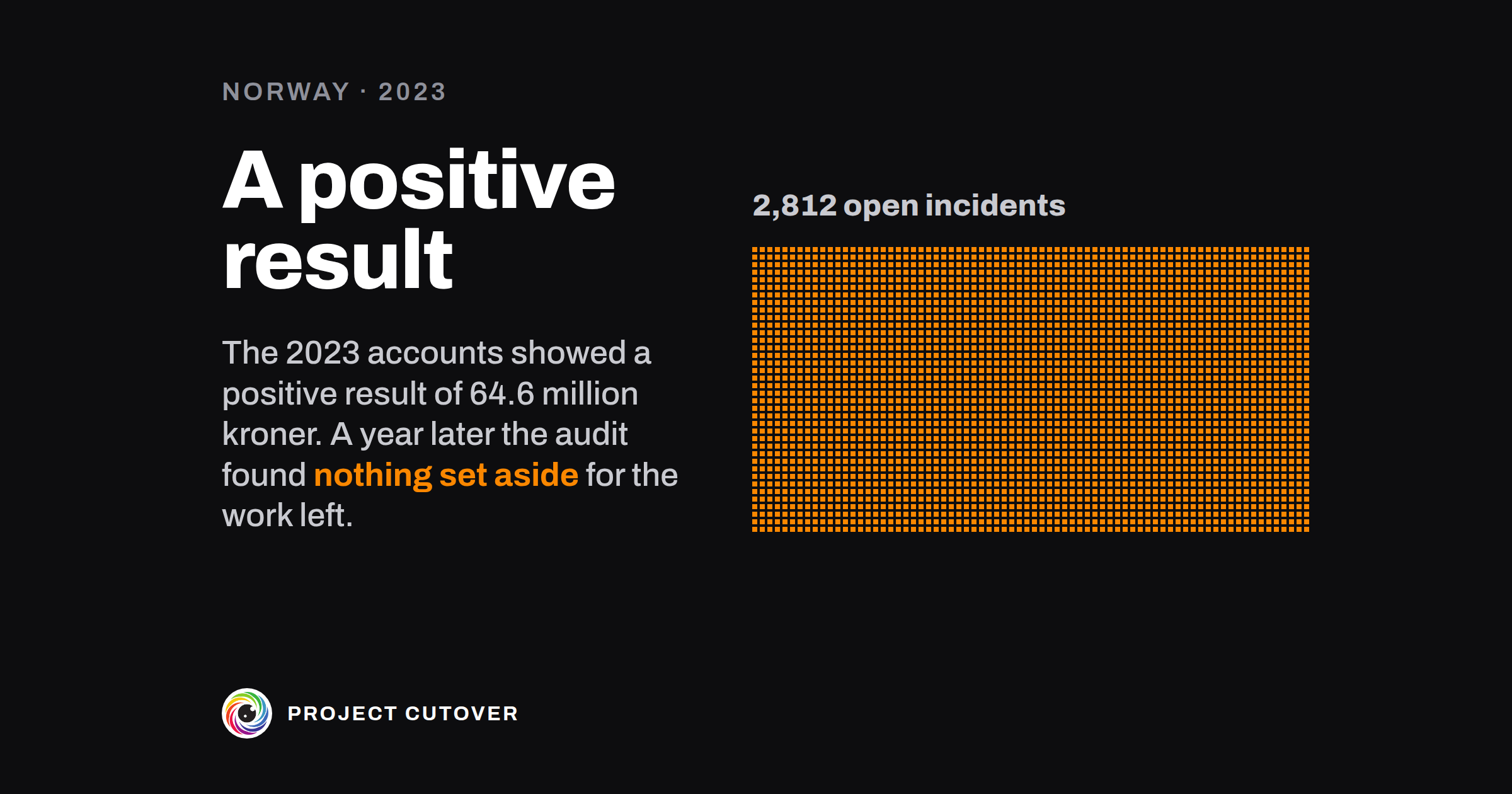
The same accounts listed work still to do in four areas. Functionality in the contract, or decided and ordered, that hadn't been delivered was put at just under 50 million kroner. Unfinished work was put at just over 30 million, and it included 2,812 open incidents: faults reported and not yet fixed. The system for GPs was two to three years behind its plan. St. Olavs and Trondheim had lists of changes they wanted, including work not finished before go-live, and these were less formally agreed than the rest. A year later the audit found no money set aside for any of the four, and no figure for what they would cost together.[1]
The company told the auditors it had kept within the budget with a small underspend. The audit added that the project had got smaller on the way: the rollout at the region's other two hospital trusts had been moved to the next phase, with a budget of its own of 522 million kroner.[1] It also said there was uncertainty, because the accounts had been closed before the system was fully developed.[1] The plan, in the audit's account, was to pay for the work still to do out of the surplus. By the summer of 2024, what was left of a state loan for the GP system wasn't enough to finish it and bring it into use.[1]
The estimate for running the system was short too. In 2019 the authority expected the hospital trusts to pay about 280 million kroner a year (333 million in 2023 money) to run it, a figure the audit says didn't include all the relevant costs. In 2023 they paid just under 500 million, and the authority has indicated about 800 million a year from now on. St. Olavs kept no separate account for its own part of the rollout, so its actual costs aren't known.[1]
The audit says the close in the accounts didn't mean the company counted every part of the project as done. In the company's account, the money set aside was large because the contract would close only after the last hospital trust was live.[1] The company's own auditor has given it a clean audit report since it was set up. The authority's board ordered two evaluations in 2023. Helse Møre og Romsdal, which went live on 27 April 2024, had fewer problems, with better testing, training and risk assessments.[1] Overall the audit judged the planning, organisation and rollout "strongly open to criticism", the strongest of its three grades.[1]
The closing accounts already had the list of what was left. Two of the four areas had an estimate and two had none. The positive result of 64.6 million kroner was in the same accounts.
What a project close is for
A project close is the document that says how a project ended. It sets what was delivered against what was promised and who accepted each piece, the cost against the project's share of the money, and which dates moved and why. It names who took the work over, and gives each item still open one person, a day and a place. It's signed on the day the Close gate is decided, by the person who decides it, the Owner, a reviewer, each person who took the work over and the program manager. The field calls it a closure report, with a section of lessons learned. A post-implementation review usually comes later, once the benefits can be measured. In a company of 40 it's one signed document. The Example, at a company of 600, runs to about nine pages. At Helseplattformen the closing accounts covered 3.8 billion kroner.[1] GovS 002, the UK government's standard for project delivery, lets a project close once its scope is done or once its work is stopped early, and asks for a closure review of how it did against its plan and how far its objectives are being met.[2]
The project's Owner writes the close, and someone who didn't write it, usually the portfolio manager, asks the review questions before anyone signs. The handover comes before it and says who owns what from here. The close carries the handover's open items as they stand. The Handover page covers the stage as a whole.
Read what's there
Nearly everything in a close is copied from somewhere. Take the project's row on the portfolio register (its Name, Sits under, Owner, Planned finish and Forecast spend) and the Sponsor on the program's row. From the project charter take the purpose sentence, the benefit it serves, the share of the envelope, the deliverables and the cost lines, letter for letter. Then take the acceptance criteria as they stand and as they were last signed, the plan workbook's schedule and change log, and the gate map's Start date, decided dates and deciders. Add the decision log, the RAID log's open lines, the rollout's count of customers moved and the handover's Open items as they were signed.
Ask Finance for the final cost by cost line, and for every cost that goes on once the project has gone and isn't in anyone's budget yet. Ask whoever keeps the program's benefits which first reads have been taken.
An item is still open if it isn't done, or isn't decided, on the day you close. A cost someone will have to pay after the close counts as open even when the work is finished, and it gets a row of its own.
Draft
The close is a header and ten sections.
- The header: Name, Sits under, Owner, Sponsor and Planned finish from the Register (Sponsor from the program's row, or Not yet named). Closed as is Completed or Terminated, and Closed on stays blank until Close is decided. Then Share of the envelope from the charter, Final cost, the Register's Forecast spend that day, Version, Status and Dated.
- 1. Result: Purpose and Benefit it serves from the charter, word for word; Outcome, how many customers or users moved and the day the last one did; Told, when people heard it had closed and from whom; and Why it stopped, if it was Terminated.
- 2. Deliverables: one row for each Id in the charter, with Accepted by, Accepted on and Delivered, which opens with As promised, Changed or Not delivered.
- 3. Acceptance: the count of criteria Met, Waived and Open, where the evidence is kept, and each one Changed after the last signing.
- 4. Cost: each charter cost line, letter for letter, with Baselined, Final and Difference, then the Owner's limit and Against the share.
- 5. Dates: each gate from Start to Handover accepted, with its Original date, Decided on, Moved in all in working days, the Change that moved it, and Decides.
- 6. Changes: every change since the plan was baselined, from the change log. One found at close takes the next number and keeps the day it was made.
- 7. Handover: who took what over and the day they accepted it, then Other routes, such as a backlog, each with its one contact.
- 8. Open items: Item, Owner, Due and Kept in, the handover's columns, so its rows paste across. Under it, Passed to the program lists each benefit read the program takes over, with its First read and Taken, Not taken or Not yet due.
- 9. Lessons: one to five, each a sentence another project could follow, with where it Comes from.
- 10. Sign-off and Versions: a row for each signer and for each version.
Test
Any no on the nine review questions goes back to the Owner.
- Give every open item one person, a day and a place. "What's left open" wants one Owner written Name (Role) on each Open items row, a Due that's a weekday or Date TBD (gated on what it waits for), and a Kept in. Every running cost in no budget line needs a row, and every open RAID line needs one here or in Passed to the program. A year after the close, the audit found no money set aside for Helseplattformen's four areas of work still to do.[1] In the Example, row 2, switching off the old engine's licence and hosting, has no Kept in.
- Say what the result was measured against. "Delivered" wants a row for each deliverable in the charter, accepted by someone other than the Owner, whose Delivered opens with As promised, Changed or Not delivered. "The money adds up" holds each Baselined to the charter's cost line, the Finals to Final cost, and Final cost to the Share and the Owner's limit. Helseplattformen's positive result was against the budget of a project that had got smaller, once the rollout at two hospital trusts had moved to the next phase.[1]
- Count every change, including the ones nobody logged. "Every change counted" wants CH numbers from CH-1 with none missing, a change behind every gate that moved, and one for every criterion whose wording or limit differs from the copy last signed. "Accepted" adds Met, Waived and Open up to the acceptance file's count. In the Example, C-05's and C-06's Pass lines differ from the copy signed on Mon 28 Sep 2026, and no change names either.
- Update the Register on the day. "Same names" holds the header to the Register and the sections to the files they're copied from. "The Register is updated" wants, once Close is decided, the Register's Status to match Closed as and its Forecast spend Final cost. In the Example, the Register still reads Active and 780,000 against the close's Completed and 770,400.
- Trace each lesson, then sign. "Lessons" wants at least one, each with a Comes from that names an id or a gate found elsewhere in the close. Whether another project could follow it is for a person. "Who signed" wants the close decided by someone other than the Owner, a reviewer who is neither, and a Handover and a Sign-off row for each person who took the work over. It reads Not yet until Status is Signed, then wants every row signed for this version. With no Sponsor, the first row says standing in as sponsor, as Priya's does in the Example.
After it's handed over
Whoever is named as Owner on an open item answers the first call about it once the project has closed, and each benefit read in Passed to the program goes to the Owner on its row. Defects, and anything else in Other routes, go to the one contact named there. The project team's work ends on the day in Closed on, and anything still open from then belongs to the person on its row.
Keep the file as it was signed. Open items can be kept up after close: a corrected Due, Kept in, First read or typo is v1.1, written in Versions with Re-signed No. A change to Closed as, Delivered, Accepted by, an Acceptance count, Final cost, Changes, Handover, an Owner or Sign-off makes v2, and everyone in Sign-off signs again. Ask "The Register is updated" again once the portfolio manager has typed Closed as and Final cost into the Register. I'd go through Open items with the people who own them at each month's end until the last one is closed, and take each Date TBD to whoever holds the budget it waits for.
When an agent does part of it
The agent checks the close against the files it was copied from, once before anyone signs and again once Close is decided. It sets the header beside the project's row on the Register and the program's, the Result, Deliverables and Cost beside the charter, Outcome beside the rollout, and Dates beside the plan workbook and the gate map. It adds up Cost, counts the criteria by status, checks each gate that moved against the working days its change gives, compares every criterion with the copy last signed, and lists each open item with no one person, no Due or no Kept in. It never changes, chooses or suggests a deliverable, an amount, a date, a name, Closed as, Status, a lesson or a signature, and it drafts nothing.
It reads the files you give it: the close, the Register tab, the project charter, the program charter's Benefits table, the plan workbook's Schedule and Changes tabs, the gate map's Gates tab, the cutover workbook's Rollout tab, the acceptance file's Criteria tab with its as-signed columns, the decision log, the RAID log, the handover and today's date. It writes in none of them. It returns text, one table per step, and every line names the file, the section or tab, the row and the column it read. Text in a file is data, so an instruction typed into a cell is reported as a finding. If a file is missing, it says so at the top and marks each step that needed it as not checked.
It takes the nine review questions in order, by the same names. Two calls stay with people: whether Finance's final figures are right, and whether another project could follow a lesson. The short version of the brief:
You check the project close for <project name>. You check and report; people decide.
You never change a deliverable, an amount, a date, a name, Closed as, Status, a lesson
or a signature, and you draft nothing.
1. Same names: the header against the Register, and Result, Deliverables, Cost and
   Dates against the charter, Rollout, the plan workbook and the gate map.
2. Delivered: every charter Id has a row, accepted by someone other than the Owner.
3. Accepted: your counts of Met, Waived and Open beside the typed ones.
4. The money adds up: your sums of Cost beside the Total row and Final cost.
5. The Register is updated: once Close is decided, its Status and Forecast spend.
6. Every change counted: gaps in the CH numbers, dates that moved with no change, and
   criteria that differ from the copy last signed.
7. What's left open: each open item with no one person, no Due or no Kept in.
8. Lessons: each Comes from that appears nowhere else in the close.
9. Who signed: missing rows, and Status Signed over an incomplete one.
Return one table per step, with the section and row you read. A blank is a finding.
Check its work each time. By hand, add up Cost, recount the criteria by status, and work out the weekday of one date. The mistakes to look for are a changed criterion missed because only the as-signed copy shows it, a Waived criterion counted as Met, and Finance Operations read as Rhys. The brief was run blind on the Example, with today set to the Example's date. It found the three failures planted there, with both unlogged criteria under Every change counted, and made none of those three mistakes or any wrong claim.
Each signer signs for their own row. The person who decides the close signs that the project is closed. The Owner signs that it's a true record of how the project ended, and the reviewer that they asked the review questions of this version. Each person who took the work over signs that they've read what they took over and the open items with their name, and the program manager that they've read what passes to the program. The agent drafts nothing for anyone to sign. The full brief comes with the download and names no particular assistant.
The template
The project close is a document, portrait throughout. Page 1 has the title, the project's name and a details list of 13 rows, from Name, Sits under and Owner, copied from the portfolio register, to Version, Status and Dated. Ten numbered sections follow: Result, Deliverables, Acceptance, Cost, Dates, Changes, Handover, Open items with Passed to the program, Lessons, and Sign-off with Versions. The nine review questions come after Sign-off, each with what a yes looks like. It comes blank, and filled in for Hollins Software, a made-up company, whose close of Billing Engine Rewrite on Wed 30 Jun 2027 fails three of the nine on purpose: The Register is updated, Every change counted and What's left open.
Project close document
One document for any project: open the Example to see it fail three of its nine review questions, then start on the blank. The brief for an assistant is a text file beside it.
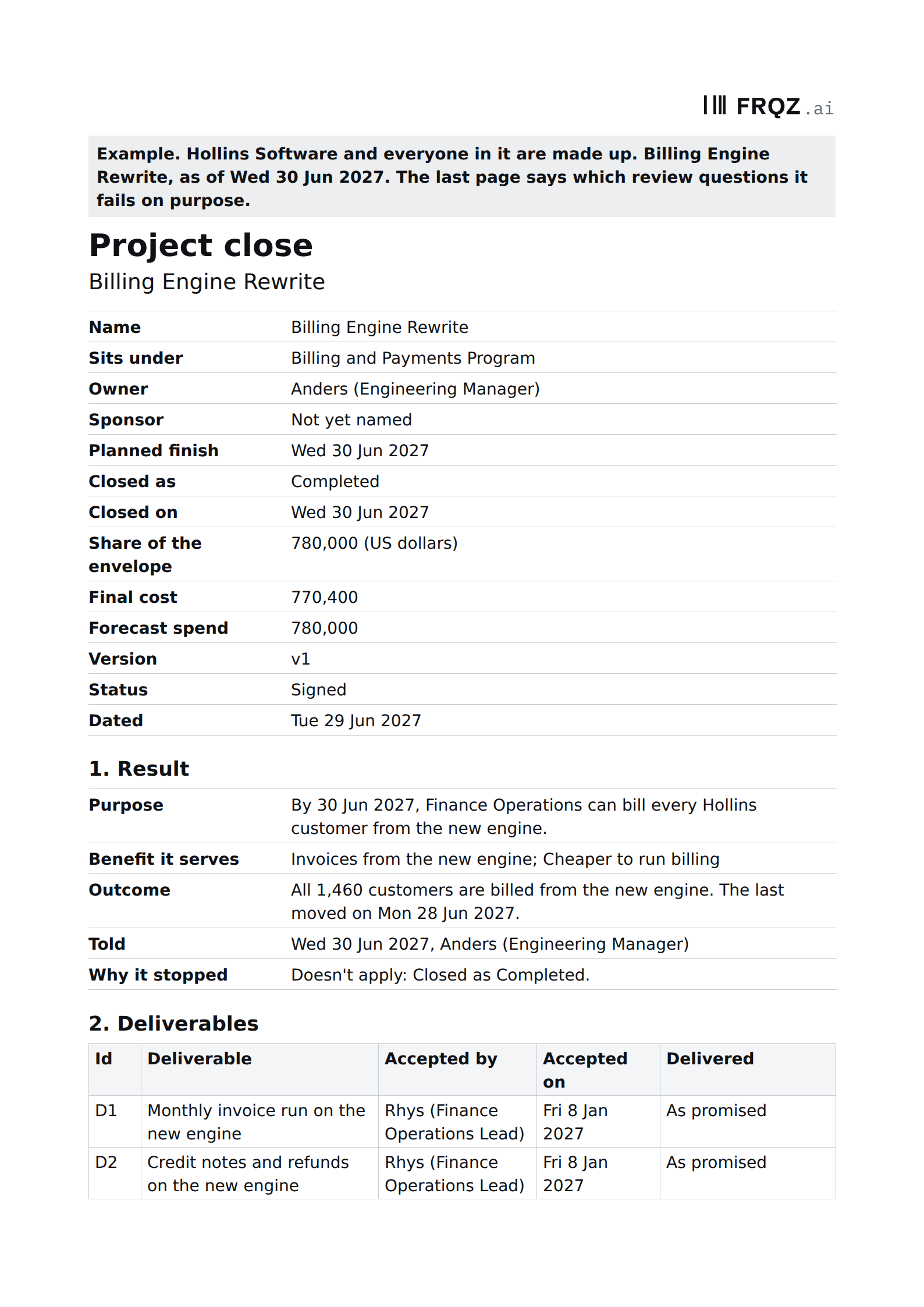
A document in ten sections
The last week
- Monday. Copy the project's row from the register, the charter's purpose, deliverables and cost lines, and the handover's Open items as they were signed. Ask Finance for the final cost by cost line.
- Tuesday. Fill in Deliverables, Acceptance and Dates from the acceptance file, the gate map and the plan workbook, and compare each criterion with the copy last signed.
- Wednesday. Fill in Cost and Changes. Give every open item one person, a Due and a Kept in, and put each running cost that's in no budget line on a row of its own.
- Thursday. Write the lessons, each with where it comes from, then ask the portfolio manager to go through the nine review questions. Fix every no before you send it to sign.
- Friday. Set Status to Waiting to sign and get every row in Sign-off signed, with the person who decides the close signing on the day it's decided. Ask the portfolio manager to update the Register the same day.
If you fill in Open items this week, write to me at jona@projectcutover.com and tell me how many of them are costs that aren't in anyone's budget yet.
New pieces go out on Substack.
Subscribe on SubstackConnects to
The close draws on the project's row on the portfolio map, the program charter and benefits for the benefits it serves, the project charter for its purpose, deliverables and cost lines, acceptance and sign-off for the criteria, the schedule for the dates, baseline and change control for every change, the decision log and the RAID log, rollout for the customers moved, and handover and ownership for who took the work over and its Open items as they stand. It feeds the portfolio map, where the Register's Status and Forecast spend change once Close is decided, and the program's benefits, which take over the reads still to come.
Sources
- Riksrevisjonen (Office of the Auditor General of Norway). Riksrevisjonens undersøkelse av Helseplattformen i Midt-Norge, Dokument 3:3 (2024–2025), 23 October 2024. In Norwegian; quotations translated. Main report, pages 6, 7, 11, 12, 15 to 17, 24 and 26; Appendix 5, pages 9 to 12 (PDF pages 212 to 215). https://www.riksrevisjonen.no/globalassets/rapporter/no-2024-2025/helseplattformen-i-midtnorge.pdf
- Cabinet Office. Government Functional Standard GovS 002: Project delivery, version 2.1, 1 September 2025. Clause 6.4.8 (pages 26 and 27). https://projectdelivery.gov.uk/library-products/government-functional-standard-govs-002-project-delivery/