
Head of series
Answers: what will the work take, and who agreed to it?
Électricité de France (EDF), the French state-controlled electricity company, wanted to build a new kind of reactor at Flamanville, in Normandy.[2] The European Pressurized Reactor (EPR) there would be the "head of series", the first of its design. It was to be in service in 2012, so that a series could be launched from 2015 and enter service from 2020, as France's first 900-megawatt reactors reached 40 years.[1]
In December 2003 a consortium of Areva, also state-controlled,[2] and Siemens won a Finnish order for an EPR on turnkey terms, offering to build it in 48 months for 3 billion euros.[1] On 22 June 2004 EDF's board unanimously approved the launch of what became Flamanville 3. EDF's chairman told the board that the Finns should pour their first concrete early in 2005, "two years ahead of EDF", and that the gap between the Finnish reactor and EDF's own shouldn't be allowed to grow too wide.[2]
On 6 May 2006 the board took the formal decision to build. The project was estimated at 3.2 to 3.3 billion euros in 2005 money, with 54 months of construction. The first concrete was poured in December 2007, and commissioning was announced for June 2012.[1]
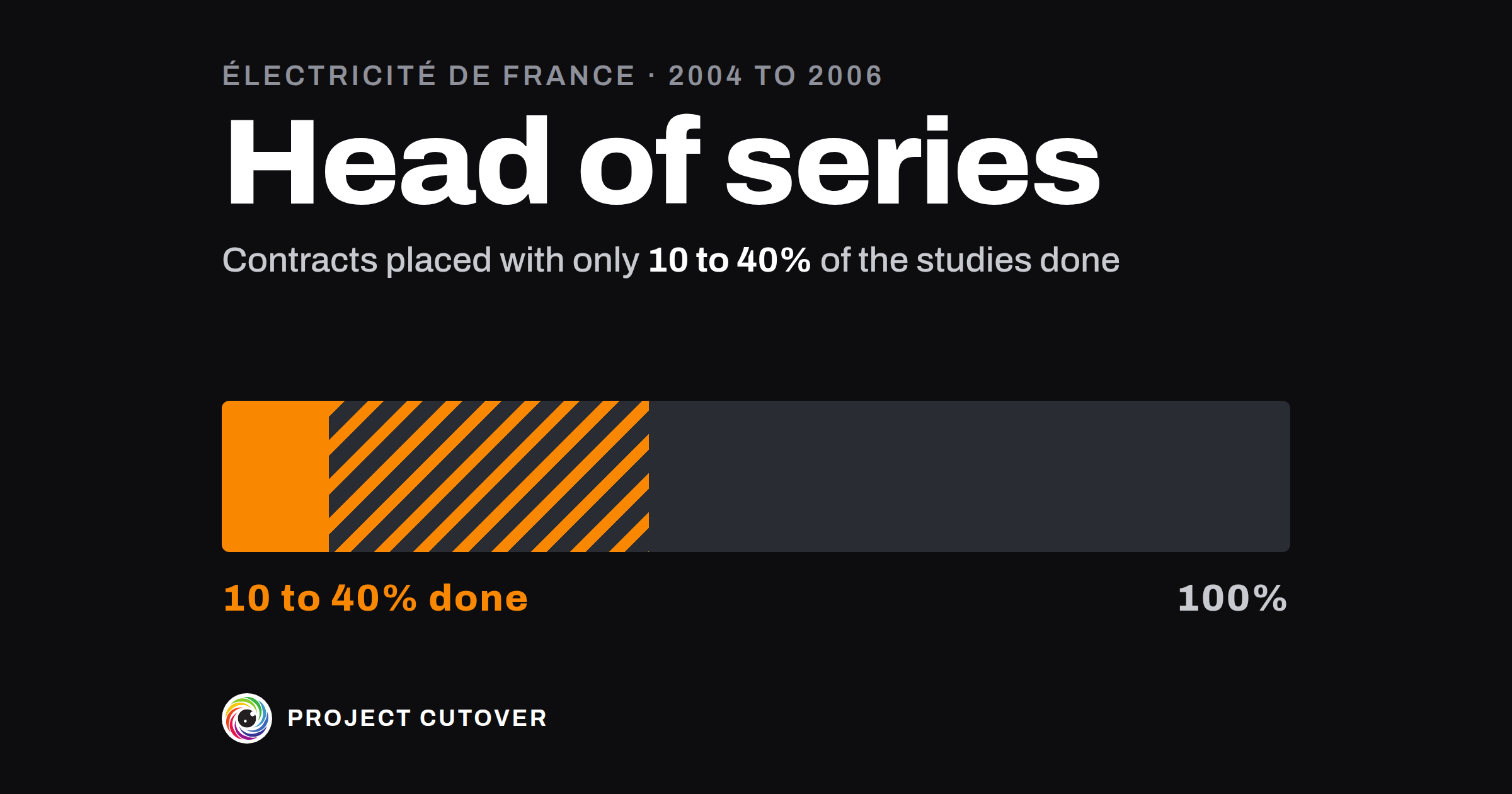
A review that EDF's chairman ordered in 2019 found that when the project was launched in 2006 the reactor's basic design was finished, but its detail engineering had "barely begun".[1] The Cour des comptes, France's national audit court, reported the next year that the main construction contracts had been placed when "only 10 to 40 percent" of the studies needed were done, depending on the contract.[2] The project as set up in 2006 had no clearly identified head. The job passed through several managers in turn, each also running other things, until a full-time project director was appointed in 2015.[1] At the launch there was no schedule shared with the contracting firms and no forecast of the cost to complete.[1]
The engineering would need 22 million hours against the 5 million estimated, and close to 4,500 changes were made after construction began.[2] The review counted eight successive versions of the overall design, where a project far enough along at launch and properly prepared should need three at most.[1] The Court found that for the first five years of construction spending was added up with no view of the final cost, and that the first estimate built on the work remaining came at the end of 2012.[2] By the Court's report of July 2020, the construction cost was estimated at 12.4 billion in 2015 euros, 3.3 times the first forecast, and construction at about 187 months.[2]
Later, EDF brought in specialist consultancies and hired many people who knew how to run complex projects, and the missing tools were gradually put in place.[1] Two reactors of the same design went into service at Taishan, in China, in 2018 and 2019, "with success" in the Court's words, though five years late and 60 percent over budget.[2] In 2020 EDF planned to start building its next design, the EPR2, only once 70 percent of the detail studies were done.[2]
When the board committed in May 2006, with commissioning announced for June 2012, the project's management expected 40 percent of the studies to be done by the first concrete, which left 3 million of the 5 million hours still to do.[1]
What a plan is
A plan is the project's work written down in enough detail to agree to: all of the work, who owns each piece, how long each should take and on what basis, the order it happens in, and what it costs. The field calls it a project management plan. When it's agreed it becomes the baseline, the version progress is measured against, and from then on each change to it is asked for and approved. In a company of 40 the plan might be one workbook of a few dozen rows, drawn up in a couple of weeks. On this site it's one plan workbook, shared by the four parts below.
GovS 002, the UK government's standard for project delivery, asks for plans that show milestones, activities, schedule, cost and resources, and the assumptions and risks behind them.[3] Planning may be "iterative and progressive", with more detail for the near future than for distant work, and plans should be updated, especially before decision points such as gates.[3] The standard runs planning and control through the whole life of a project and lets each project choose its own stages.[3] On this map Plan is the stretch of a project from its start to the gate called Plan baselined, and planning carries on through Run, Cutover and Handover.
Who runs it
GovS 002 makes planning the job of the manager at each level: the project manager for a project, a team manager for a piece of work inside it.[3] It asks for planning done together, with the people doing the work advising on how their own part is planned, and for one person accountable for every piece of work and every activity.[3]
In a company of 40 the project manager is often an engineering lead, who drafts the plan with the engineers who'll build it.
What it decides
Plan decides how the work will be done and what it will cost, in money and in time. GovS 002 names "approving plans and baselines" as one of the decisions to be made on a project, and says an approved plan must be baselined.[3] That approval is the Plan baselined gate on the Project page's gate map, with its criteria and the person who decides it.
Each manager should be given limits on cost, time, scope and more, within which they don't need to escalate.[3] What the plan can't fit inside the charter, such as more money or a later end date, goes back up to the sponsor. After the gate, a change to the baseline goes through the part called Baseline and change control.
Its parts
- Work breakdown The whole job, split into pieces small enough for one person to own. Answers: what's all the work?
- Schedule The order the work happens in, and the chain of tasks that sets the end date. Answers: when will it be done?
- Estimates How long each piece should take, and where the number came from. Answers: how sure are we of that date?
- Baseline and change control The plan everyone agreed to, and how a change to it gets asked for and approved. Answers: who agreed to that change?
New pieces go out on Substack.
Subscribe on SubstackSources
- Jean-Martin Folz. La construction de l'EPR de Flamanville, report to the chairman and chief executive of EDF, October 2019 (in French; quoted words translated by Project Cutover). Pages 5, 6, 7, 18, 19, 21, 22 and 34. https://www.vie-publique.fr/files/rapport/pdf/271429.pdf
- Cour des comptes. La filière EPR, public thematic report, July 2020 (in French; quoted words translated by Project Cutover). Pages 12, 13, 15, 27, 29, 31, 36, 63, 64, 95 and 98. https://www.ccomptes.fr/sites/default/files/2023-10/20200709-rapport-filiere-EPR.pdf
- Cabinet Office. Government Functional Standard GovS 002: Project delivery, version 2.1, 1 September 2025. Clauses 4.3, 6.3, 7.1, 7.2.2, 7.2.4 and 7.2.5. https://projectdelivery.gov.uk/library-products/government-functional-standard-govs-002-project-delivery/